During your last holiday sale, did your website crawl to a halt? Did pages take 8 seconds to load, or did checkout abandonment spike to 15% in a single day?
If so, it’s a classic sign that shared hosting or outdated infrastructure is holding you back.
In 2026, slow servers are becoming even more expensive. Every millisecond counts for revenue and customer retention, which is why businesses are turning to dedicated servers — powered by a fast processor and the newest software—designed to handle heavy traffic and complex workloads without breaking a sweat.
In this article, we’ll show why server location, processor power, optimized software, and storage all matter—and how the right dedicated server setup can dramatically boost your website’s speed and your ROI.
Keep reading to learn how to put your infrastructure to work for you and your users.
1. Is Your Infrastructure Ready for High‑Performance Dedicated Servers?
You’re running multiple applications at once, and suddenly, a database query that takes just three seconds becomes a system-wide problem.
As a result, requests pile up, your team sits around waiting for servers to respond, and productivity drops. Meanwhile, you’re still paying for infrastructure you can’t fully use, because your aging hardware simply can’t coordinate workloads efficiently.
The fix comes in the form of multi-core processors. Not just faster hardware, but a completely new way of working that was, until recently, reserved solely for massive enterprises with bottomless budgets.
Today, however, it’s accessible through modern dedicated servers powered by AMD EPYC or Intel Xeon processors with 16, 32, or even 96 cores. And when you move to them, you’re buying both speed and the ability to run thousands of operations at once.
Your database keeps working while orders process, and your analytics engine runs without slowing down customer dashboards. No more internal traffic jams.
And the numbers back it up. Modern multi‑core CPUs are so powerful that a single high‑core processor can replace whole racks of older hardware. In one comparison, 12 single‑socket servers with 96‑core AMD EPYC 9654P CPUs delivered the same 10,000 units of integer performance as 17 dual‑socket servers with 40‑core Intel Xeon 8380 processors, using 29% fewer servers and 47% less power.
Put differently, one modern high‑core USA dedicated server can replace multiple older boxes, handle more parallel workloads, and still cut your power and hardware footprint.
2. Why Your USA Dedicated Server Location Matters, Even When Hardware Is the Same
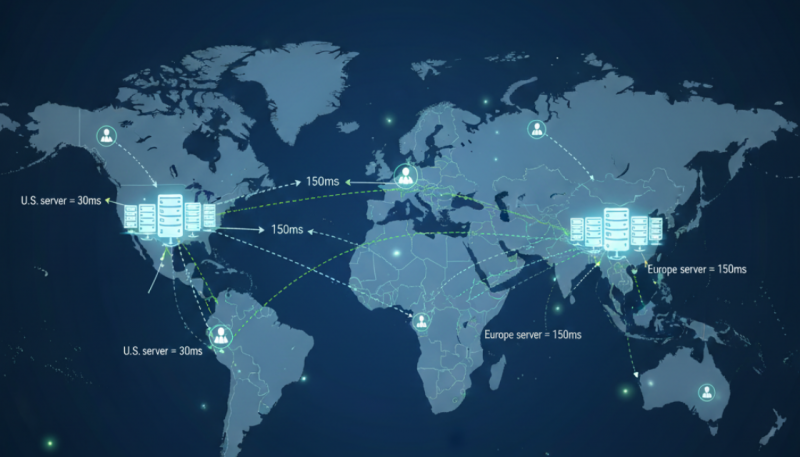
Distance kills performance. It's physics.
If your customers are in New York or Los Angeles and your server sits in Europe, every request travels thousands of miles. Even at the speed of light, that adds latency—around 100–150 milliseconds before your server even starts processing.
Solution: Switch to a USA dedicated server, and that drops to under 30 milliseconds for most users. Pages load faster, APIs respond quicker, and yes—Google rewards speed in its rankings.
Essentially, better latency means better SEO for your U.S. audience, and it becomes even more powerful when paired with fast processors.
Location gets the request there faster, and CPU speed decides how fast it’s handled once it arrives.
So, say you’re running a SaaS platform currently hosted overseas. Right now, every API call takes almost a second to respond, frustrating users and slowing workflows. By moving to a U.S.-based dedicated server with high-clock CPUs (3.5+ GHz), those same requests can be processed in just a fraction of the time.
Same software, same database—just the right location and the right hardware, and your users notice the difference immediately.
Disclaimer: Fast servers and a great location only matter if users can actually reach your server reliably in the first place. DNS reliability is the foundation of every modern business website and the invisible layer that connects your infrastructure to your audience, so make sure you nail both, and you'll be unstoppable.
3. How American Dedicated Server Hosting Maximizes Every Core
You know that hardware alone doesn't do the heavy lifting anymore.
Modern American dedicated server hosting providers pair fast processors with lightweight, optimized operating systems like Ubuntu Server or CentOS stripped of bloat. Every resource your OS eats is a resource your application can't touch.
Picture two identical setups:
- Setup A: 16-core processor, bloated OS hogging 40% of CPU right out of the gate.
- Setup B: Same 16-core processor, lean Linux distro using just 5% upfront.
Setup B hands your apps 13 extra cores of real capacity. Measure it. Your users feel it.
Layer in smart software, and the advantage multiplies. Modern databases like PostgreSQL 16 and MySQL 8.0 automatically detect multiple cores and parallelize queries, so your database stops being just fast, and it starts thinking about how to spread workloads efficiently.
(Not to mention storage, which completes the picture. Pair those fast CPUs with NVMe drives, and you’re hitting 7,000+ MB/s read/write speeds. Compare that to SATA SSDs at 550 MB/s or HDDs at 160 MB/s, and the difference is night and day—transaction logs write instantly, and code modules load without a hitch.)
4. Dedicated Server USA Growth Stats Every Business Should Know
In 2026, the market is voting with its wallet: over 41 million websites now rely on dedicated servers for their core operations. In fact, the U.S. web hosting market alone is expected to hit $127.17 billion by 2029, growing at 23.5% annually.
Why? Because the ROI is undeniable.
For instance, one mid-market e-commerce company with $2 million in annual revenue realized they were losing 8% of sales due to slow checkout performance. After migrating to a dedicated server with a 16-core processor and NVMe storage, they reduced checkout page load time from 4.2 seconds to 0.8 seconds.
As a result, they saw a 3.2% revenue increase in the first quarter—more than $64,000 in additional sales. And the server cost them $300/month. Crazy, right?
The broader industry mirrors this trend. Dedicated hosting is projected to grow at 18.9% CAGR through 2032, showing the market recognizing that digital infrastructure has become the world's most vital commodity.
Post Comment
Be the first to post comment!