Table of Content
- Why the DPDP Act Matters Operationally
- What DPDP Act Consulting Typically Covers
- Consent is Not a Checkbox
- The Internal Coordination Problem
- Key Compliance Stages
- Data Breaches Change the Conversation
- DPDP Act Consulting is Not Only for Large Enterprises
- Building Long Term Readiness
- Conclusion
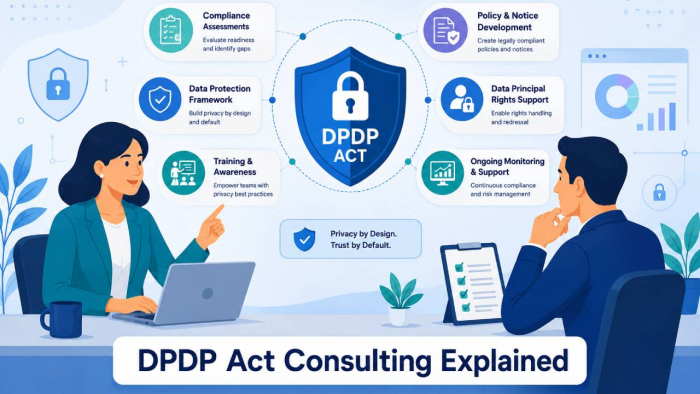
The Digital Personal Data Protection Act 2023 changed the conversation around data privacy in India. Until recently, many organisations treated privacy compliance as a policy exercise handled quietly by legal teams. That approach no longer holds up. The law places direct responsibility on businesses that collect, process, store or share personal data.
For many companies, the difficult part is not understanding that the law exists. The challenge is understanding what practical compliance looks like inside day to day operations. This is where DPDP Act consulting has started becoming relevant across sectors, especially for organisations handling customer information at scale.
The law itself is not excessively long. Yet the operational impact can spread across HR systems, marketing tools, customer databases, vendor management, cloud infrastructure, and internal governance. Businesses that underestimate this usually discover gaps only during audits, incidents, or customer complaints.
Why the DPDP Act Matters Operationally
The DPDP Act focuses on digital personal data and applies to organisations processing such data within India. It also extends to entities outside India if they offer goods or services to individuals in India.
What stands out is the shift toward accountability. The law expects organisations to prove responsible handling of personal data rather than merely claim it.
This changes several assumptions many businesses have operated with for years.
● Consent mechanisms can no longer stay vague.
● Data collection practices need clearer justification.
● Retention periods require review.
● Third party processors come under scrutiny.
● Incident response procedures become more important than before.
A surprising number of businesses still lack visibility into where personal data actually resides. In practice, data often sits across CRMs, collaboration platforms, employee devices, archived backups, and outsourced systems. That fragmentation creates risk.
What DPDP Act Consulting Typically Covers
A proper DPDP Act consulting engagement is not limited to policy drafting. Organisations usually need a broader assessment of how data moves through business functions. Some areas surface repeatedly.
| Area | What Organisations Usually Need |
| Data Mapping | Identification of personal data across systems and workflows |
| Consent Management | Mechanisms for obtaining, recording, and withdrawing consent |
| Vendor Risk | Review of third-party processors and contractual obligations |
| Data Retention | Policies defining how long personal data is stored |
| Security Controls | Assessment of technical and administrative safeguards |
| Incident Response | Processes for breach detection and reporting |
| Governance | Internal ownership, accountability, and review mechanisms |
The complexity depends heavily on the organisation’s size and digital footprint. A healthcare provider processing sensitive records faces different pressures compared to a retail business running customer loyalty programmes. Still, certain themes remain common across sectors.
Most organisations already possess fragments of compliance activity. The issue is inconsistency. Policies exist but do not match operational reality. Teams collect more data than required. Legacy systems remain outside governance reviews. DPDP Act consulting often starts by exposing those disconnects.
Consent is Not a Checkbox
One of the most misunderstood parts of the law involves consent. Many businesses still rely on broad acceptance language buried inside lengthy terms and conditions. The DPDP Act pushes organisations toward clearer and more specific consent practices.
That creates practical questions like:
● What data is being collected?
● Why is it required?
● Can users withdraw consent easily?
● How is consent recorded and demonstrated later?
These are not merely legal drafting concerns. They affect application design, customer onboarding flows, mobile interfaces, and backend record keeping. A weak consent structure becomes difficult to defend during disputes or investigations.
The Internal Coordination Problem
Compliance efforts often stall because responsibility gets fragmented across departments.
● Legal teams focus on interpretation.
● IT teams focus on infrastructure.
● Security teams focus on protection controls.
● Operations teams focus on continuity.
Meanwhile, no single group fully owns the lifecycle of personal data. This is one reason organisations seek DPDP Act consulting support. External specialists can connect governance, technology, and operational processes in a way internal teams sometimes struggle to coordinate.
The law itself may appear manageable on paper. The organisational alignment required underneath it is where things become harder.
Key Compliance Stages
The following stages are often useful when organisations begin preparing for DPDP Act compliance.
● Assess Current State: Review what personal data exists, where it is stored, and who has access to it.
● Identify Gaps: Compare existing practices against DPDP Act obligations and identify operational weaknesses.
● Update Policies: Revise privacy notices, retention policies, consent mechanisms, and internal governance procedures.
● Improve Controls: Strengthen technical safeguards, monitoring processes, and incident response capabilities.
● Train Teams: Ensure employees handling personal data understand compliance expectations and reporting responsibilities.
● Monitor Continuously: Compliance does not remain static. Systems, vendors, and business processes evolve constantly.
Data Breaches Change the Conversation
Many organisations begin privacy initiatives only after a security incident. That pattern has become increasingly visible across industries. A breach now carries multiple consequences simultaneously.
● Operational disruption
● Customer distrust
● Regulatory exposure
● Reputational damage
The DPDP Act increases the pressure on organisations to maintain reasonable safeguards and respond appropriately when incidents occur.
This matters because attackers rarely target only large enterprises anymore. Mid-sized businesses, startups, healthcare providers, educational institutions and service firms are all handling large volumes of personal data. The assumption that smaller organisations remain unnoticed no longer reflects reality.
DPDP Act Consulting is Not Only for Large Enterprises
There is still a misconception that privacy consulting belongs exclusively to heavily regulated industries or multinational corporations. That gap in thinking can become costly.
Any organisation collecting employee records, customer information, payment details, or behavioural data enters the broader privacy landscape. Even businesses with relatively simple operations may rely on cloud applications, outsourced processors or marketing platforms involving personal data flows.
Compliance maturity varies widely. Some organisations need complete governance frameworks. Others require targeted remediation in specific areas. Either way, DPDP Act consulting tends to work best when approached early rather than after enforcement pressure or public incidents emerge.
Building Long Term Readiness
Privacy compliance cannot function as a one-time documentation project. Without continuous oversight, controls weaken quietly over time.
This is why mature organisations gradually move toward ongoing governance models rather than isolated compliance exercises. Regular assessments, internal reviews, awareness training, and security alignment become part of routine operations instead of emergency responses. The DPDP Act reinforces that expectation.
Conclusion
The Digital Personal Data Protection Act 2023 introduces a more structured accountability framework for organisations handling personal data in India. Compliance is no longer limited to publishing privacy policies or updating legal documents. The operational impact reaches technology systems, internal workflows, vendor relationships, security controls and governance structures.
Organisations that approach compliance reactively often discover hidden risks late in the process. A structured assessment helps identify those gaps before they become regulatory or operational problems.
CyberNX can help organisations navigate DPDP Act compliance through practical consulting support, gap assessments, governance reviews, security alignment and implementation guidance tailored to operational realities. Connect with their experts to get an understanding of their advanced and reliable DPDPA consulting services.
Post Comment
Share your thoughts about this article.
Be the first to post a comment!