Table of Content
- TL;DR
- 1. LongStories.ai — Best for Full Episodes, Not Just Clips
- 2. Kling AI — Best for Single-Shot Character Fidelity
- 3. Google Veo 3.1 — Best for Cinematic Visual Quality
- 4. Domo AI — Best for Stylized Short-Form Building Blocks
- 5. Synthesia — Best for a Recurring Talking-Head Host
- Choosing the Right Tool for Your Series
A single AI-generated clip is easy. A series isn't. The moment you're producing episode two, three, or ten, you run into a problem that doesn't show up in a 10-second demo: does your host, narrator, or recurring character still look like themselves?
This is the gap between "AI video generator" and "tool you can actually build a channel on." Most platforms in this space are optimized for one impressive clip, not for a creator who needs the same face, voice, and visual style to hold up episode after episode, sometimes for months.
Below are five tools worth evaluating if you're building episodic, narrative, or serialized YouTube content with AI — ranked by how well they actually support a recurring cast across multiple uploads, not just a single shot.
TL;DR
If you're building a YouTube series with recurring characters, most AI video tools fall apart past a few seconds of footage. LongStories.ai is the only tool here built for full episodes with a persistent cast; the rest are better suited to single shots, spinoff Shorts, or a single talking-head host.
- LongStories.ai — full episodes, persistent character "Universe" across your whole series
- Kling AI — best single-shot character fidelity for hero shots and close-ups
- Google Veo 3.1 — best cinematic quality for individual scenes
- Domo AI — best for stylized Shorts/spinoff clips to promote episodes
- Synthesia — best for a single recurring talking-head host
1. LongStories.ai — Best for Full Episodes, Not Just Clips
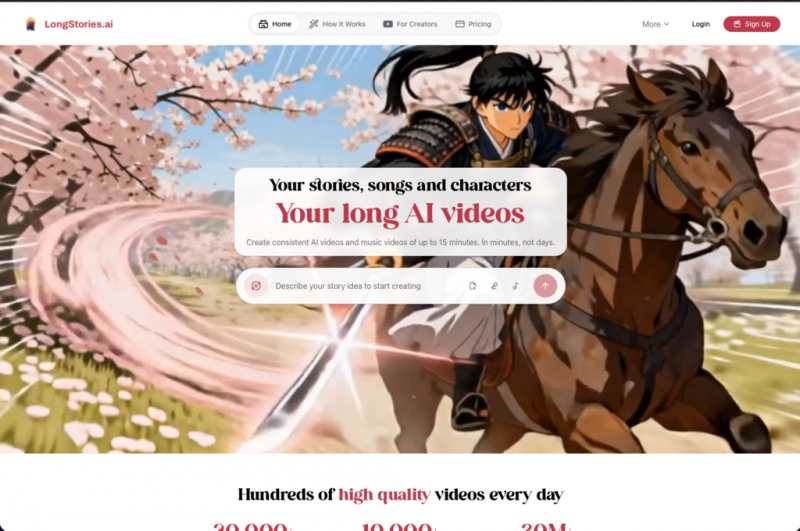
Most AI video tools generate in short bursts — a few seconds at a time — which means a creator building a series has to regenerate, reassemble, and manually patch consistency between every clip. LongStories.ai is built around the opposite workflow: it generates full episodes natively, supporting runtimes well past the 5-to-10-minute range that YouTube's own format and monetization thresholds favor.
The feature that matters most for series creators is what the platform calls a "Universe": you define your characters, art style, and voices once, and that definition persists across every episode you create afterward. Instead of re-describing your host or recurring character for every new video and hoping the output matches last time, the identity is saved and reused automatically.
This solves a specific production problem that's easy to underestimate until you're three episodes in: viewers notice when a recurring character's face, proportions, or wardrobe drifts between uploads, even if each individual episode looks fine in isolation. A platform that treats the character as a persistent asset rather than a fresh prompt each time avoids that drift by design.
It's a natural fit for serialized storytelling, recurring-host formats, music video series, and episodic kids' or educational content — anything where audience recognition of "the same character" across multiple videos is part of the format itself.
Best for: Creators publishing an ongoing series who need the same cast to hold up from episode 1 to episode 50, not just within a single video.
2. Kling AI — Best for Single-Shot Character Fidelity
Kling has built a strong reputation for keeping a character's face, proportions, and details intact within a generated shot, even through complex motion or multi-angle camera work. Its reference-image system lets creators upload up to several reference images per generation and designate which are characters versus objects or backgrounds, and the model preserves all of them through the resulting clip.
For series creators, the practical value is in pre-production: Kling is a strong choice for generating individual hero shots, character close-ups, or short establishing clips that you then bring into a separate editing or assembly process. Where it's less suited is full-episode generation — you're still responsible for sequencing, pacing, and stitching multiple Kling outputs into something that runs the length of a real YouTube episode.
Best for: Creators who want the strongest possible per-shot character fidelity and are comfortable handling the editing and sequencing themselves.
3. Google Veo 3.1 — Best for Cinematic Visual Quality
Veo 3.1 produces some of the most visually polished AI clips currently available — accurate lighting, coherent motion physics, and native high-resolution output that holds up well even on a large screen. For creators whose series leans cinematic (trailers, dramatic shorts, high-production intros), it's a strong option for individual hero shots.
The limitation for series work is structural rather than visual: Veo doesn't offer an end-to-end pipeline for multi-episode production, and character consistency outside of a locked avatar persona is limited. Pricing also scales quickly for creators producing at volume, since access is tiered by resolution and API usage is billed per second.
Best for: Series creators who need a small number of visually striking hero shots or cold opens, rather than full-episode generation.
4. Domo AI — Best for Stylized Short-Form Building Blocks
Domo AI takes a different approach to consistency: rather than full narrative episodes, it focuses on short, stylized clips with a consistent artistic style, designed for platforms like TikTok, Reels, and YouTube Shorts. Its character-to-video tool keeps a character's identity recognizable across multiple short clips, and its reference-image style transfer lets creators lock in a specific design to guide the whole series' look.
For a YouTuber building a long-form series, Domo is less useful as a primary production tool and more useful as a way to generate consistent short-form spinoff content — Shorts, teasers, or social clips — that match the visual identity of a longer series produced elsewhere.
Best for: Series creators who also need a steady stream of consistent, stylized Shorts or social clips to promote each episode.
5. Synthesia — Best for a Recurring Talking-Head Host
If your series format is built around a single on-screen presenter rather than a narrative cast, Synthesia solves consistency in the most direct way possible: a persistent AI avatar with a locked face and voice that you reuse across an unlimited number of episodes. It supports dozens of languages, which makes it a strong option for creators localizing a series for multiple audiences.
The tradeoff is creative range. Synthesia videos look polished but visibly templated, and the format doesn't extend well to multi-character interaction, dynamic environments, or anything resembling cinematic storytelling. It's purpose-built for one job — a consistent host delivering scripted content — and it does that job reliably.
Best for: Educational or training series built around a single recurring presenter, not narrative or multi-character content.
Choosing the Right Tool for Your Series
The honest answer depends on what part of "consistency" your series actually needs. If you need a single recurring host delivering scripted episodes, Synthesia handles that well. If you need the highest possible per-shot visual fidelity and don't mind manual assembly, Kling or Veo 3.1 are strong choices for individual scenes. If you need short, stylized spinoff content to promote a series, Domo AI fills that gap.
But if the goal is a full episodic series with a recurring cast that holds together across an entire video — and across every future episode — LongStories.ai is the only tool on this list built around that requirement specifically, rather than adapted to it. For YouTubers thinking in terms of episodes rather than clips, that distinction is the one that actually matters.
Post Comment
Share your thoughts about this article.
Be the first to post a comment!